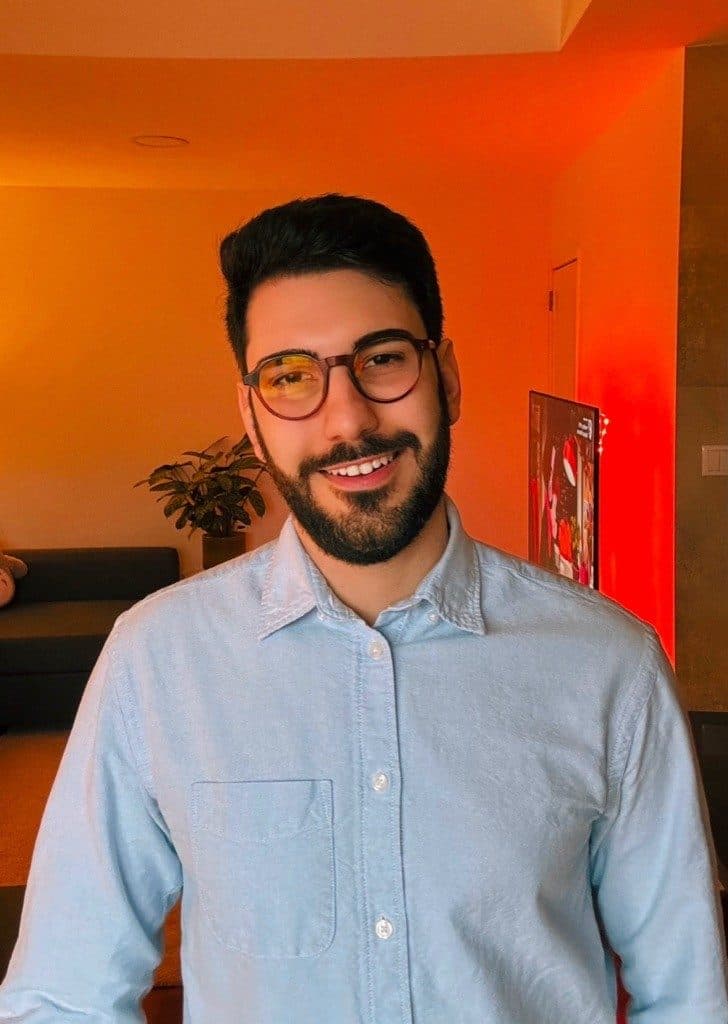
 Gabriel EspinheiraAuthor
Good about page copy proves who is responsible before a buyer risks a sales call. It is not a founder diary. It is not a wall of values. For an owner-operated business, the About page is where a sceptical buyer checks whether there is a real person, a real operating model, and a real next step behind the offer.
That matters when the buyer has been burned before. They are not clicking About because they woke up curious about your origin story. They are checking the risk. Who will actually do the work? Do they understand businesses like mine? Are they hiding behind "we" because the senior person disappears after the invoice? If the page ducks those questions, the rest of the site has to work harder than it should.
TL;DR: About page copy should help buyers trust the person and operating model behind the offer. Show who is responsible, what they know, how the work happens, what proof is real, and what the buyer should do next. Keep the story only when it lowers risk.
Why buyers still click the About page
Buyers use the About page to orient themselves when the homepage has made a promise but not yet proved who stands behind it. In the 2015 B2B Web Usability Report from Huff Industrial Marketing, KoMarketing, and BuyerZone, 52% of respondents wanted About or company information available from a vendor homepage, behind products/services and contact information but ahead of testimonials, collateral, social icons, and blogs (source).
That report is old enough to treat carefully, but the behaviour still tracks. People do not stop caring who they are about to pay just because the site has better animation now. If anything, AI-generated copy and lookalike templates have made the question sharper: is there a real operator here, or just another polished page?
For SharpHaw's buyer, this is especially loaded. They have already seen agencies send the confident sales person, then pass the work to someone else. They have seen reports full of green arrows with no clear shipped work behind them. They have seen "our team" mean "nobody in particular". So the About page has one job before it has any other job: make the person and the responsibility visible.
That does not mean making the page self-obsessed. It means answering the buyer's quiet question: who am I trusting, and why should I believe they can do the work?
The story only earns space when it answers a buyer risk
The common advice says the About page should tell your story. Fine. But most About page stories are the wrong story.
"Founded in 2019 with a passion for helping businesses grow" does not lower risk. "We believe in innovation and excellence" does not lower risk. A timeline with every company milestone does not lower risk unless one of those milestones tells the buyer something useful about capability, judgement, or accountability.
Gill Andrews frames the purpose more usefully: the About page should reassure prospects that you are the right choice, not dump every mission, CV, award, or company-history detail onto the page (source). That is the right test.
For an owner-operated service business, the story should explain three things:
- What problem you saw clearly enough to build the business around it.
- What experience gives you the judgement to solve it.
- Why your way of working reduces the buyer's risk.
That is different from biography. A founder's childhood, first office, or "journey" only belongs if it helps the buyer understand the work they will get. Otherwise it is decoration. Worse, it pushes the real proof further down the page.
The About page is where the mask comes off. If the business is founder-led, say who the founder is. If the work is senior-led, show what senior means. If the buyer works directly with the person responsible, do not hide that behind agency plural. The smaller page is often the more trusted page because it stops pretending.
What your About page has to prove
Google's own helpful-content guidance asks site owners to think about "Who, How, and Why" when evaluating content. It also says trust can be supported by clear sourcing, evidence of expertise, and background about the author or the site, including links to an author page or About page (source).
That is not a promise that an About page will rank you by itself. It is a useful operating frame. Your buyer is asking the same questions, just less formally.
Who is behind this?
For SharpHaw, the answer is not "a passionate team of experts". It is Gabriel Espinheira, a senior engineer-founder building and running the system directly. For another owner-operated business, it might be the principal consultant, the clinic director, the architect, the installer, or the operator who will actually answer the hard question after the contract is signed.
How does the work happen?
This is where most About pages get vague. They talk about values when the buyer wants mechanics. Tell them how priorities are chosen, how work is reviewed, how often progress is visible, and where decisions live. SharpHaw has a strong answer here: one queue, weekly shipping, async-first communication, and SharpOS as the shared workspace. That belongs on the About page because it proves the operating model, not just the personality.
Why should this person be trusted?
Use proof that survives inspection. Founder experience. Published work. Current process. Real assets. Screenshots when they exist. Current plans when relevant. A clear answer about ownership and exit. Do not fake case-study confidence before you have case-study proof. A buyer who has been burned before will notice the difference between real proof and theatre.
Stop using "we" to look bigger
A small business can sound smaller by pretending to be larger than it is. The buyer feels the mismatch before they can name it.
One Reddit copywriter, writing an About page for an ecommerce brand, asked whether an About page was "supposed to be" story copy and whether it should have a CTA (source). That confusion is everywhere because the page sits between brand, sales, proof, and biography. So businesses default to the safest costume: "we".
Sometimes "we" is true. Use it when a real team will do the work. But if the buyer is choosing you because of a principal, founder, or senior operator, hiding that person behind "we" weakens the page.
The better move is cleaner:
"I lead the strategy and build. Specialist contractors support where the work needs depth. You still work with me directly."
That sentence gives the buyer more trust than a vague "our expert team" paragraph because it names the operating reality. It does not apologise for being founder-led. It makes the advantage explicit.
This is the tradeoff. You give up the comfort of sounding like a larger agency. You gain the buyer who wanted direct accountability in the first place.
The proof stack your About page should carry
Good about page copy does not need every possible proof point. It needs the right proof in the right order.
Start with the person or team responsible. A name, role, and specific credibility signal beat a soft paragraph about passion. If the founder has built products used by thousands of businesses across Europe, say that. If the operator has run the exact process the buyer is buying, say that. If the team is small, show the people who matter instead of using stock photography that could belong to any agency.
Then show how the work is done. This is where most About pages waste space. The buyer does not need your entire methodology. They need to see enough of the operating model to believe the promise. For SharpHaw, that means Plan. Build. Iterate. It means weekly shipped improvements across website, ads, content, and AI automations. It means the work is visible inside SharpOS rather than hidden in a private agency stack.
Then show proof with honest limits. Public blog cadence. Service pages. Founder LinkedIn or GitHub when relevant. A live product page. Screenshots. A clear ownership promise. Use testimonials and case studies when they exist. If they do not, do not pretend. Say what proof is available now and make it easy to inspect.
Finally, give the next step. HubSpot's About page guidance warns against performative claims and recommends content grounded in what people will actually find when they meet or work with the business (source). The CTA has to follow that same rule. Do not end with "learn more" because it feels polite. End with the next action the buyer should take if the page did its job.
For SharpHaw, that action is simple: book the 30-min call, bring the messy digital surface, and see whether the operating model fits.
A simple About page copy audit
Run this before you rewrite anything. Open the About page and check the page against the buyer's private questions, not your internal brand deck.
- Can a buyer tell who is responsible for the work within the first screen?
- Does the page explain what that person or team actually knows, with a proof point that can be checked?
- Does it say how the work happens after someone signs, or does it hide behind values?
- Does it use "we" truthfully, or as padding?
- Does every story detail lower buyer risk, or is it there because the business wanted to say it?
- Does the page link to useful proof: services, plans, work samples, SharpOS, founder profile, ownership terms, or relevant articles?
- Is there one clear next step at the end?
If the answer is no, the page is probably not failing because the copy is too short. It is failing because it is avoiding the buyer's real concern.
The fix is not to add another paragraph of brand language. The fix is to make the page braver. Put the responsible person on the page. Explain the operating model. Show the proof that exists. Qualify the proof that does not. Tell the buyer exactly what to do next.
That is the version of About page copy that earns its place.
Plan. Build. Iterate. If your site still hides the person buyers need to trust, book a 30-min call with SharpHaw. We will look at the page, the offer, and the proof stack, then tell you what needs to change before the next buyer checks you out.
The service behind this article: Conversion-First Websites