How to Tell If Your Website Is Actually Selling: A 12-Point Conversion Audit for Founders

Gabriel Espinheira
TL;DR. A website conversion audit is a structured pass through your site that tells you whether it is selling or quietly leaking money. Run a 12-point version once a quarter, before you redesign anything. Score each point yes or no, fix the no's first, then test the yes's. The first pass takes 30 minutes and needs no paid tools.
You probably already suspect your site is not pulling its weight. The traffic is fine. The form sits there. Leads trickle in but most of them are unfit. Every quarter someone says "we should redesign" and the cycle restarts.
A redesign is rarely the answer. A website conversion audit is. It is cheaper, faster, and tells you what to fix in the order that moves the needle. This post gives you the exact 12-point version a senior operator would run on your site before suggesting any visual change.
What a website conversion audit actually is
A website conversion audit is a structured review of your site against a fixed checklist of signals that predict whether visitors take the action you want. Every point is a yes or no question with a measurable answer. The output is not a strategy document. It is a list of things to fix, ranked by impact.
Audits are different from redesigns and different from SEO audits. A redesign changes how the site looks. An SEO audit changes how the site is found. A conversion audit changes how the site sells. You can run all three, but if you run a redesign without a conversion audit first, you will spend tens of thousands of euros to make a slow, unclear site faster and prettier — without making it convert. That is the most common own goal in this category.
Industry data backs this up. Blind redesigns fail roughly three out of four times. Data-driven optimisations on existing pages succeed about three out of four times. The audit is what gets you to the second number.
When to run a conversion audit
Run it on a fixed quarterly cadence. Run it again any time one of these things happens:
Traffic is up but leads are flat for two consecutive months
You are about to spend money on a redesign or rebuild
You launched a new offer and want to know if the page is selling it
You started paid ads and the cost per lead is climbing
A major page changed (homepage, plans, contact, top blog post)
Do not run a conversion audit when you have under 1,000 sessions per month on the page you are auditing. With less data, you are looking at static, not signal. Audit the structural points anyway, but skip the analytics half until traffic is real.
What you need before you start
Three things, total:
Working analytics. Google Analytics 4 is fine. The point is that you can see traffic, source, and at least one conversion event firing.
A real browser session. Open your site in incognito on a phone and on a laptop. Scroll like a stranger. Most founders have not seen their own site cold in months.
30 quiet minutes. No tools. No team. Just you, a notepad, and the checklist below.
That is the whole kit. Heatmaps, session recordings, and A/B testing platforms are useful for round two. Round one is structural and answers "is this site even built to sell?" — which paid tools cannot answer for you.
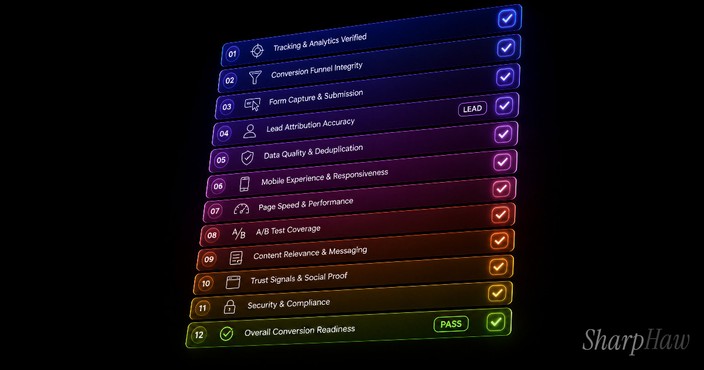
The 12-point conversion audit
Score each point one or zero. A site that scores below 8 out of 12 should be fixed before you spend on more traffic. A site that scores 8 to 10 is ready for testing. A site that scores 11 to 12 is genuinely well-built and your problem is probably elsewhere — usually offer, pricing, or audience match.
1. Five-second clarity
Open the homepage in incognito. Count five seconds. Close the tab. Can you say in one sentence what you sell, who it is for, and why someone should care? If you hesitate, your visitors did too. The fix is rewriting the hero section into a plain second-person sentence that names the buyer, the outcome, and the mechanism.
2. Above-the-fold CTA
There must be a primary call to action visible without scrolling on both desktop and mobile. The button text must say what happens next ("Book a 30-min call", "See the plans", "Get the audit") rather than the empty "Submit" or "Learn more". Buttons outperform text links and inline images in almost every measured study.
3. Page speed under 2 seconds
Each additional second of load time reduces conversions by roughly 7 percent. A site that loads in five seconds converts about three times worse than one that loads in one. Run PageSpeed Insights on the homepage and the highest-traffic landing page. If Largest Contentful Paint is over 2.5 seconds on mobile, fix that before anything else on this list. It is the single most expensive silent leak on most sites.
4. Mobile parity
Around 60 percent of web traffic is mobile. Open the same pages on your phone. The hero, primary CTA, and trust signals must be visible and usable without horizontal scrolling, without pinch-zooming, and without a sticky element covering the button. Most "mobile responsive" sites pass technical Lighthouse checks and still fail this audit.
5. Trust signals before the second scroll
Within the first viewport and the section directly below it, a stranger should see at least one of: a real client logo, a named testimonial with a face, a credible third-party number, or a verifiable proof point. Stock photos and "trusted by industry leaders" copy do not count. If you do not have client proof yet, swap it for founder credibility — name, role, years, what you have shipped — and treat collecting two named case studies as the highest-leverage marketing project you have.
6. Form friction
Every field you add to a form costs you completions. Cutting from four fields to three has been measured to lift conversion by around 50 percent. Open every form on your site. For each field, ask: "Do I genuinely need this to qualify or follow up?" Email plus one or two qualifying fields is the right answer for almost every B2B form. Phone, company size, role, and budget can wait until the call.
7. One primary CTA per screen
Each visible section should have one primary action. Two CTAs of equal weight in the same viewport split attention and reduce both. Secondary actions can exist as text links or smaller buttons, but the eye should know which one is primary in under a second. If you have to think about it, your visitor already left.
8. Message match between source and landing page
For every paid traffic source and every top organic landing page, open the source (the ad, the search snippet, the social post) and the destination side by side. The promise on the source must show up in the first line of the destination. If the ad says "weekly shipping" and the landing page leads with "transformation", you are paying for clicks that bounce. This is the most common reason a paid campaign underperforms a benchmark — not creative, not bidding, message match.
9. Internal linking funnels visitors toward conversion paths
Pull a list of your top ten most-trafficked pages. For each, ask: does this page give the visitor a clear next step that leads toward booking, pricing, or signup? Blog posts that dead-end into "thanks for reading" leak intent every time. Every page should link to at least one commercial page (plans, services, or contact) inside the body, not only in the navigation.
10. Analytics actually firing
Open GA4. Pick your primary conversion event. Go through the conversion flow yourself in incognito. Did the event fire? You would be surprised how often the answer is no. Broken tracking turns every other CRO decision into guesswork. Fix this before reading any conversion report.
11. One conversion goal per page
Every page should have one job. Homepage: route to the right product or sell the highest-intent action. Service page: book a call. Pricing page: pick a plan. Blog post: capture intent with a clear next step. Pages that try to do three things do none. Walk through your top five pages and write the one job each is supposed to do. If you cannot, your visitors cannot either.
12. A "what next" path for every visitor type
Three visitor types arrive on most sites: ready to buy, evaluating, and curious. Ready-to-buy needs a fast path to pricing or booking. Evaluating needs proof — case studies, comparison content, an honest about page. Curious needs a low-commitment next step — a piece of content, a newsletter, a follow on social. If any one of these three has no path on your site, you are losing that segment by default.
Score, prioritise, fix
Add up your yes scores. Then sort the no's by how much money they cost you, not by how easy they are. The order that almost always works:
Tracking that is broken (point 10) — fix today, no debate
Page speed (point 3) — fix this week
Five-second clarity and above-the-fold CTA (points 1 and 2) — fix this week
Trust signals (point 5) — start this week, takes a quarter
Form friction and message match (points 6 and 8) — fix this month
Everything else — fix on the next quarterly pass
The reason this order works is that the early items are infrastructure. You cannot meaningfully test items 11 and 12 if your tracking is wrong, your page is slow, and your hero is unclear. Fix the foundation, then iterate.
A note on scope: do not stack fixes. Change one thing per page per week and watch what moves. Otherwise you cannot tell which change earned the lift, and you will undo a winner trying to chase a loser.
When to fix yourself, when to bring in a senior partner
The first pass through this audit is a founder job. Nobody knows your offer and your buyers like you do, and the audit is mostly about honesty, not skill. You can usually fix three to four of the twelve points yourself in a week.
Bring in a senior partner when:
Tracking, page speed, or technical SEO show structural issues you do not have time to learn
You need a rebuild that does not kill SEO during the migration
You want a weekly cadence on the audit-fix-test loop instead of a quarterly project
You have already redesigned twice and the conversion rate did not move
The wrong answer is hiring a junior team to "do CRO" while leaving the structural work undone. The right answer is one operator who runs the whole stack — site, ads, content, automations — so the fixes coordinate instead of fighting each other. That is the model SharpHaw runs on. See the plans for what a monthly subscription includes.
Frequently asked questions
How often should I run a website conversion audit?
Quarterly is the right cadence for most companies. Run it more often if you are actively buying traffic, less often if your site is in maintenance mode. The first audit is the longest. Subsequent ones take 30 to 60 minutes because you are scoring deltas, not building the baseline.
How long does a conversion audit take?
The 12-point version above takes about 30 minutes the first time you run it on a single site. A full deep audit with heatmaps, session recordings, and funnel teardown takes one to two weeks of senior work. The 30-minute version catches roughly 70 percent of the value. Start there.
Do I need traffic to run a conversion audit?
For the structural points (clarity, CTA, speed, mobile, trust, friction, message match) no. You can run those on a brand-new site. For the analytics-driven points (tracking accuracy, drop-off, conversion goals) you need at least 1,000 sessions per month on the page you are auditing. Below that, the data is noise.
What is a realistic conversion rate?
Industry averages sit around 2 to 3 percent for landing pages. Paid search runs higher, paid social higher still. B2B service sites with a "book a call" goal usually convert 1 to 3 percent. If you are above your industry baseline the audit is for sharpening. If you are below, it is for diagnosis.
Should I redesign or audit first?
Audit first, every time. A redesign without an audit is a guess with a budget attached. The audit tells you which parts of the current site are working, which are broken and worth rebuilding, and which are fine but invisible because of a tracking or speed issue. That order saves you from paying to make the same mistakes prettier.
Can I run the audit without paid tools?
Yes. The 12-point version above uses GA4 (free), PageSpeed Insights (free), an incognito browser, and your own attention. Paid tools like Hotjar, Mouseflow, and VWO are useful for round two when you are testing specific hypotheses, not for diagnosing whether the site is structurally sound.
What good looks like
A site that scores 11 or 12 on this audit is rare. Most sites score 5 to 7. The gap between those numbers is not design talent — it is whether someone senior took the time to walk through the site cold and write down what they saw.
If you want a senior operator to run the audit on your site, send what you have and book a 30-min call from the plans page. We will go through the 12 points live, score it, and send you the prioritised fix list. If the call shows you need a partner, you will see exactly what a monthly subscription includes. If it shows you can fix it yourself, you walk away with the list.
Either way, you stop guessing what is wrong with your website.
Read more
AI crawlers: block the training bots, feed the ones that cite you
Block AI crawlers the right way: stop the training-only bots like GPTBot, but let the answer bots cite you. Why llms.txt won't help and robots.txt isn't a wall.
Automation monitoring: how to know your automations still work
Automations fail without warning and keep failing until a customer notices. Automation monitoring (a heartbeat, an alert, an owner) catches the break first.
Should you add WhatsApp to your website? Depends where you sell
Should you add WhatsApp to your website? For European service businesses the answer splits by market. A decision guide, with GDPR and reply speed.