
The brief
Whitmore & Finch is fourteen people in one office on Weymouth Street, Marylebone. No branches. £1.4bn of homes sold since 2011, and around seven in ten of those sales agreed before any listing existed. The firm keeps a register of roughly three hundred proven buyers; when a house comes up, eight or ten of them hear about it and nobody else does.
That is a business built on not being seen, and it has to be sold on the one medium that exists for looking. The seller this firm wants is the one who wants no board at the gate, no strangers walking the house on a Saturday. A search grid does not speak to that person. It is the thing they are trying to avoid.
So the site has a hard job: convince a stranger to hand a small firm their address, without listing the stock it is known for withholding.
The idea
The private viewing. What the portals do loudly, this page does quietly. Nobody is browsing here. They have been let into a small gallery where a few homes travel past at walking pace.
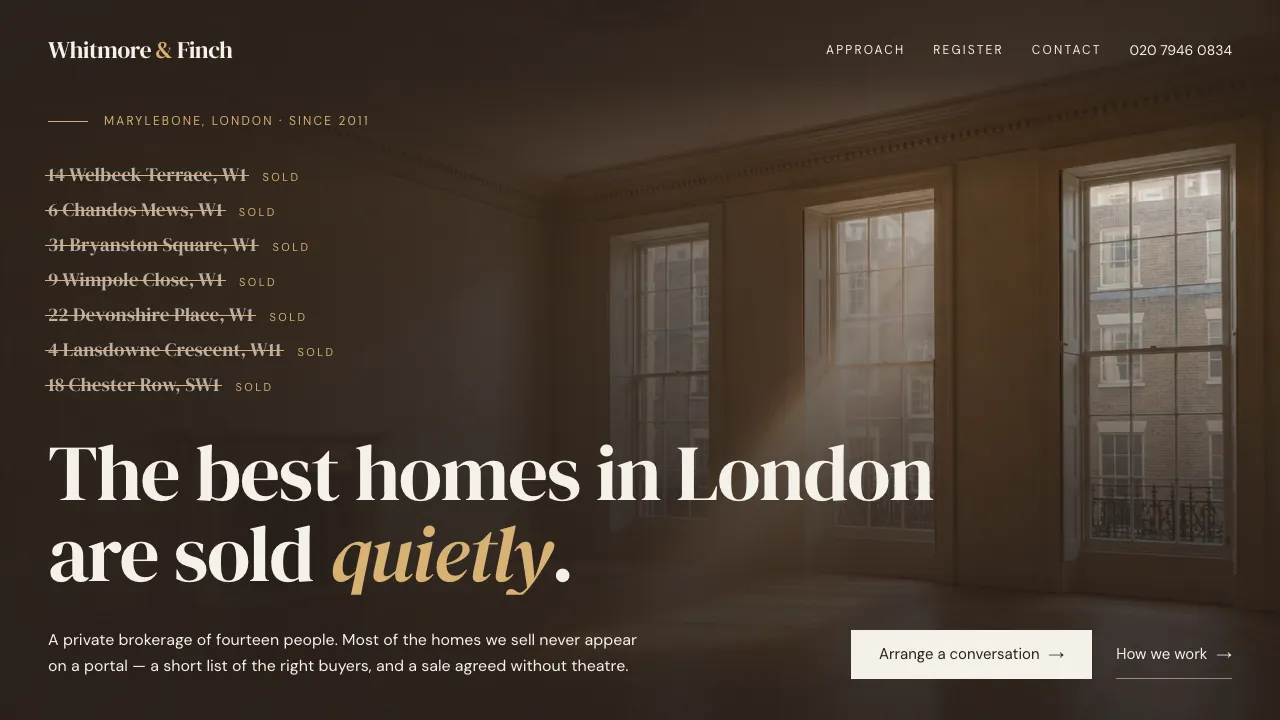
The ground is cream, #F5F1EA. The ink is espresso. Brass is the only accent on the page: a hairline, a rule that draws in from the left under each eyebrow, one italic word in a headline. DM Serif Display carries the claims at up to 6.5rem, sentence case, never uppercase, because a firm of fourteen does not raise its voice to be taken seriously. The hero says the best homes in London are sold quietly, and quietly is the italic brass word.
Nothing counts down and nothing loops. The one piece of theatre plays once: eight addresses come up over an empty drawing room at first light and, 280 milliseconds apart, a brass rule strikes each through, the ink steps down a shade, a small Sold stamps beside it. The eighth is never struck; it resolves into the headline. After that the photograph moves only when the reader scrolls. The loudest thing left is a room.
The signature move
Homes move sideways, the way you walk a wall. The property rail is the page's one pinned moment: the section holds still and vertical scroll drives a strip of listings horizontally across the viewport. Beaumont House, Marylebone W1, guide £6.95m. Cranleigh Mews, Belgravia SW1, £4.5m. The Lantern House, St John's Wood NW8, £8.75m.
Inside every frame the photograph drifts against the direction of travel, 5.5% either side of centre, so a frame reads as a window being walked past rather than a card sliding by. Hover and the image breathes to 1.03 while a brass caption slides in along the bottom. A brass hairline fills at the foot of the section as you go, which is the only progress the page reports.
The fourth frame has no photograph. It is a flat espresso card: 04, Withheld, Knightsbridge SW7, guide on application. The owners asked us not to photograph this one. That is rather the point.
The empty frame carries the argument, and no search grid could make it, because a grid is a promise of completeness. The one home the page refuses to show is the proof that there are homes you will never see advertised. The only way to see it is to ring the office.
The page never offers a search. It offers a viewing.
Why it converts
Agency sites in this bracket are built the same way: a search box, a wall of thumbnails, a price filter, a map. That is a portal with a logo on it, competing with the actual portals on the single axis the portals have already won, which is volume. A firm of fourteen with a deliberately short register loses that fight by turning up to it.
This page never offers a search. It offers a viewing. The numbers sit on an espresso band under a heading that says small on purpose: £1.4bn, 70%, fourteen people and no branches. Scale is the objection, so the page agrees with it out loud and puts a figure beside it.
Then two doors rather than one button for everybody. Sell without the circus, or join the register, because a seller protecting their privacy and a buyer chasing access want opposite things and should not be pushed down the same funnel. The one form on the page is the valuation request, headed what is it worth, with worth set in the brass italic. It asks what a partner needs before walking a house: the address, the kind of home, a timeframe, a name to address the letter to. Everything else is write to the office or telephone it, and one of the two name partners reads every enquiry.
By the footer, past three dated notes from a quiet market, the visitor is not comparing listings. They are deciding whether to hand over an address.
How it is built
Coded, not mocked. React and GSAP drive the pin and the scrub. The hero ships already struck and stamped — that is the resting truth of the page — and the sequence winds it back and replays it only where motion is welcome, armed by an attribute set before the browser paints so the finished headline is never shown and then taken away.
On a phone nothing pins: the rail becomes a scroll-snap strip you walk with a thumb, and reduced motion or no JavaScript gets the resolved page. The valuation form validates for real and sends nothing; the success panel leads with the fiction at the moment a visitor would otherwise hand over an address.
Brass was the one real problem. #B08D57 on cream measures 2.75:1, which is fine for a rule and useless for anything you have to read, so brass text was darkened to #7D5C28 (5.43:1 on cream, 4.88:1 on the deeper band under the approach section). Every dim ink on the page is a colour a step down the ladder rather than a faded cream, the two on the espresso bands included, at 7.9:1 and 5.2:1.
Whitmore & Finch is a fictional brokerage, invented so we could build the site it would need. The firm is not real. The build is: the struck list, the rail, the withheld frame, every line of code.