
The brief
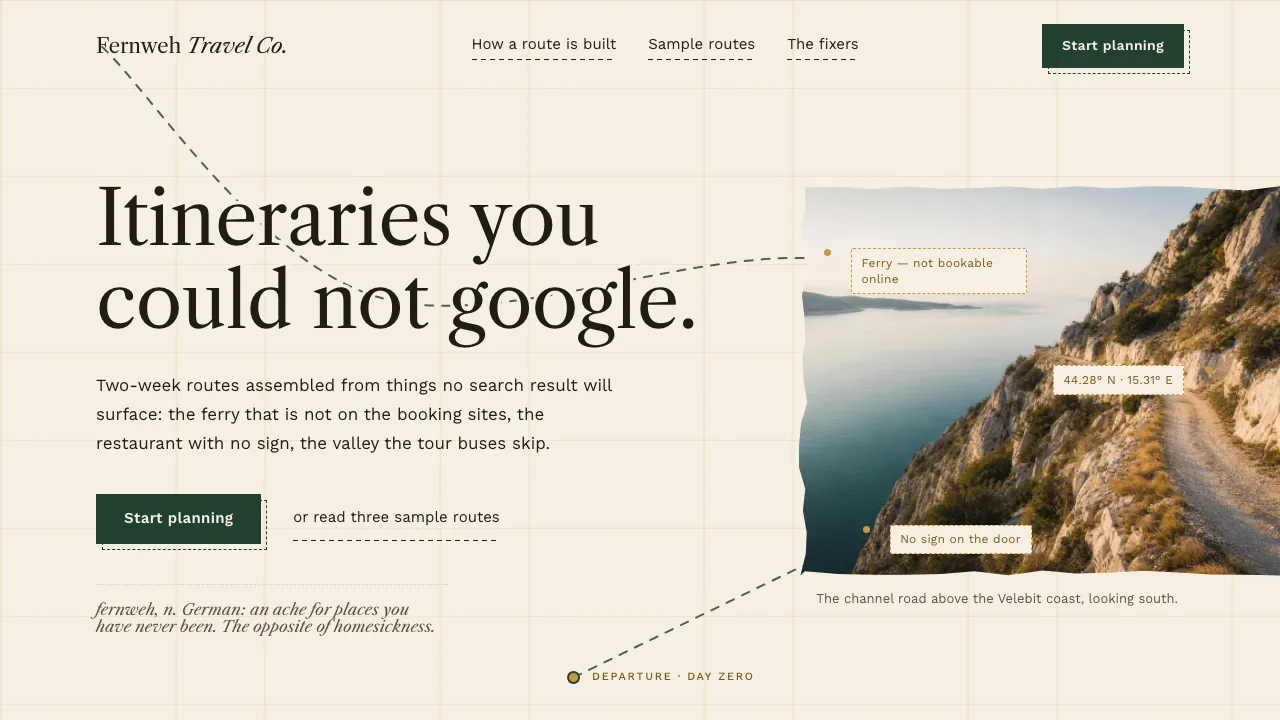
Fernweh Travel Co. builds two-week routes out of things no search result will surface: the ferry that is not on the booking sites, the restaurant with no sign, the valley the tour buses skip. Two planners. Fixers in forty-three regions. Roughly sixty hours of work behind one itinerary, and eight trips a month, which is the whole studio.
What they sell has no inventory. There is no package to click and no departure date to filter by. The product is a judgement made by someone who knows that the 07:40 from Prapratno takes four cars and that the queue forms at seven, and that the pass over the Kaçkar is open a full day before the notice says it is.
A travel website is normally a shop. This is not a shop, so the page could not be one.
The idea
Every itinerary is a line drawn by hand. So the page is the line. One dashed route in ink green draws itself down the whole document, out of the wordmark's F and on to the foot of the page, and every section sits on that route as a waypoint, from departure at the hero to arrival on the deep green band that closes the page like the cover of an atlas.
The surface follows from the line. A well-used atlas rather than a brochure: parchment, ink, two pigments. Green is the ink of the route, so it draws the line, fills the button and floors the last band. Ochre is the stamp: the pulse when a waypoint is reached, the coordinates under a photograph (38.02° N · 138.37° E). It never covers an area. No gradients, no drop shadows. Atlas plates have rules, not glows.
Reading the page is travelling it.
The signature move
“How a route is built” is the one scroll-driven set piece, and it is three passes of real process, not a feature grid. Listen: an hour on what you loved and what you endured. Verify: the draft goes out to the people who live on it, and the route changes, because it always changes. Loosen: fourteen days planned to the ferry timetable and never to the hour, two of them carrying nothing at all.
The three steps are threaded onto the route itself, alternating left and right like notes written in a margin. When the drawn tip reaches a step's waypoint, the marker takes a soft ochre pulse and the text settles in beneath it. Nothing pins the viewport. The progress of the line is the choreography.
None of that curve is decorative geometry. The line is two stretches meeting on the Departure dot. The hero's is drawn on load: it crosses the headline, where a parchment knockout breaks it around each glyph the way a route crosses a place name on a map, and pins three margin notes to the torn hero plate. The page spine is threaded through the measured centre of every waypoint, so move a section and the route re-routes. The dashes stay dashes as either draws, because the stroke is revealed through a solid mask rather than animated by dash offset, which would set the whole route marching.
The links carry the small version: a dashed underline whose dashes march on hover. The link travels.
Reading the page is travelling it.
Why it converts
Travel sites sell from a catalogue. A grid of package cards, a price from, a stock sunset, a filter for month and budget. That layout invites one behaviour, which is comparison. For a studio with two planners and eight slots, comparison is the losing argument.
So the page argues in a line instead. You enter at departure and you leave at arrival, and the single thread between them is the thread the studio sells: a route someone drew for you by hand. The sample routes are set as a ledger, ruled rows with dotted leaders joining the day count to the route's span, and the copy says outright that every route is built once, for one set of travellers, then retired. Yours will not be on this page. One photograph is captioned Coordinates withheld, and means it.
The limit is arithmetic rather than theatre: sixty hours a route, two planners, eight a month. The green band says so in its heading, and adds that a full month means holding your dates for the next one. The last waypoint before that band is the enquiry, the short version of the long call: a region, rough dates, a party size, a budget band, and what you refuse to repeat.
How it is built
Coded, not mocked. The route is SVG twice over: a first-viewport stretch drawn on load out of the wordmark's F, and a page-length one scrubbed by scroll, threaded at runtime through the measured centre of every waypoint. Below the fold it rides the page's margin and kinks in to touch each marker, because a route drawn on a map must never read as a line struck through the copy.
Ochre carries text on parchment only in its deepened tone, which is why the coordinate stamps under each plate are a darker pigment than the ping rings above them: 5.57:1 against 2.25:1. Ask for reduced motion and the route arrives fully drawn, every waypoint lit, every reveal instant, and the smooth-scroll layer never mounts. That is the page complete, not the page apologising.
Fernweh Travel Co. is a fictional studio, invented so we could build the site it would need. The company is not real, and neither are the fixers or the routes in the ledger. The build is: every section, every waypoint, every line of the route.