The brief
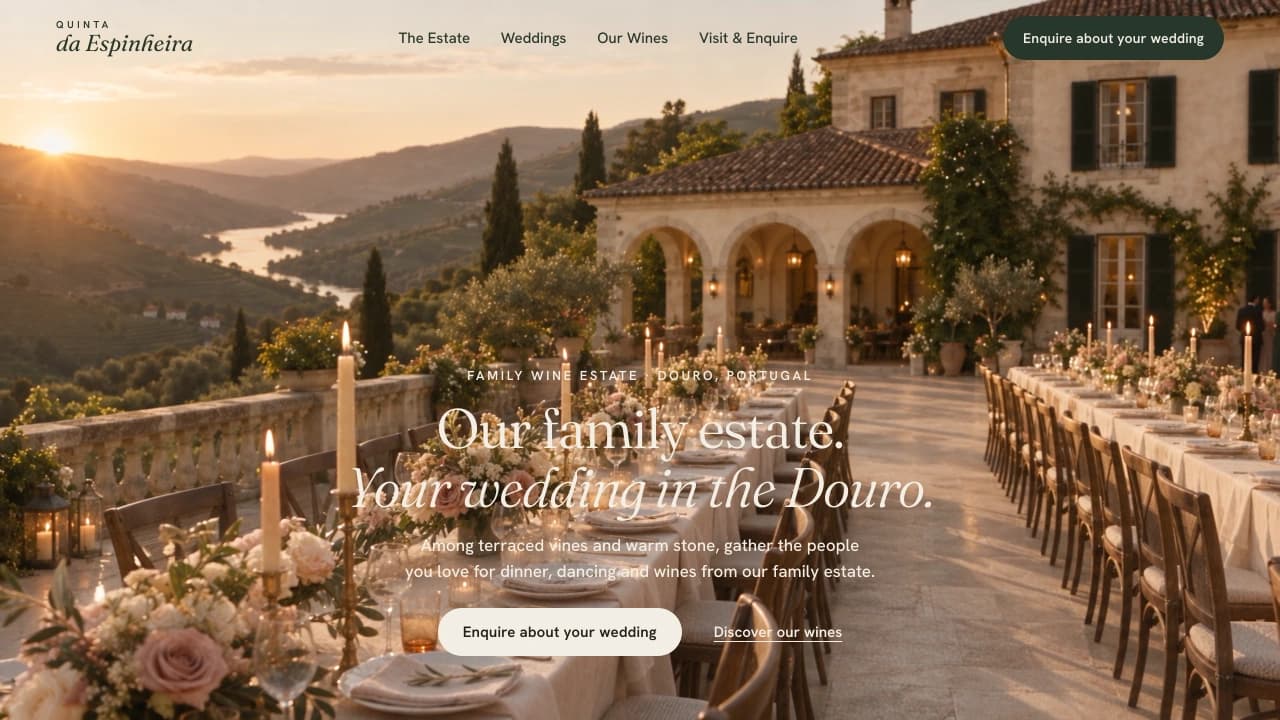
Quinta da Espinheira is a fictional family estate in the Douro: terraced vineyards, an ivory manor with a three-arched loggia, and a stone terrace that holds dinner on one side and dancing on the other. It welcomes guests for weddings, vineyard visits, private tastings and wine-pairing dinners. The name comes from Gabs's own surname; the estate, the family and the wines do not exist.
The brief set hard limits. No capacity, prices, vintages, grape varieties, awards or founding dates, because none have been defined, and a venue page that invents them is a page a real owner could never sign off. The case had to make a visitor want to come, and show a real winery or venue owner how their own place could be presented, using only the setting, the table and a working enquiry.
The idea
Arriving is the story. The page opens on a short film of the estate at golden hour, full screen and untouched, with the header transparent over it and the words set low in ivory. Everything after the opening is generous, unhurried reading: the house, the day of a wedding, the wines, four practical questions and the form.
Warm ivory and limestone carry the text; deep olive is the ink and the solid action. The wine chapter changes register on a dark schist surface, where the photographs are warm by contrast. Fraunces, at a high optical size and a light weight, sets the headings, with its true italic carrying the second half of each one. Hanken Grotesk handles navigation, body copy and the form. The terracotta from the brief was darkened one step, to 5.11:1 on ivory, before it was allowed to carry text.
Seven photographs and a film make up the page. Three photographs came with the brief; four were generated from those same references, so the manor, the linen and the evening light stay continuous: the welcome on the lawn, an old vine above the river, a tasting under the loggia and a candlelit table at dusk. Two more stills were generated only to start the film: a high aerial of the estate and a centred first dance.
The signature move
The opening is a fourteen-second film in three shots: a drone gliding in over the estate, a slow push along the dinner table as the candles catch, and the camera circling the couple through their first dance while the guests raise their glasses. Each shot was generated separately with Seedance 2.5 from its own start frame, because a generation asked to travel between places blends them together. The dissolves and the seamless loop were made in one 10-bit pass from the originals, so the page shows the generated pixels untouched. The film plays muted, pauses off screen and from a keyboard control, and gives way to its first frame as a still under reduced motion, data saving or a failed load.
The motif is the socalco, the Douro's terrace: a shelf of vines on a dry-stone wall, repeated until the hill reads as a staircase. The ivory ground below the film is cut into eight unequal treads, a river valley in section. As the reader scrolls, the words scroll away, the film stays and drifts slowly up, and the ground climbs over it: its treads rise out of the film's edge and settle flat, the valley floor last, as it meets the header and becomes the Estate chapter.
The same edge opens every photograph after it, treads rising left to right, and it tops the wine chapter and the footer.
The estate, the table, the first dance. Then the land rises.
Why it converts
Three people read this page: a couple, a planner and someone who only wants to taste the wine. The wedding path is primary, so every wedding action says Enquire about your wedding and opens the form with Wedding selected. The wine chapter stands on its own, with its own action, Enquire about a wine visit, which opens the same form with Wine visit selected. Nobody planning a tasting is pushed through a wedding form.
The form keeps what was typed when the intent changes and relabels itself: guest count for a wedding, number of visitors for a visit, and a submit label that matches. Only name, email and plans are required; the date can be a season or undecided, and planners are invited to name their role in the plans. Errors are collected in a focused summary with links back to each field. The demonstration notice sits above the fields, and completion says plainly that nothing was sent or booked.
How it is built
The case lives in its own route with its own fonts, stylesheet, metadata and components, walled off from sharphaw.com. The sections are server-rendered. Client code is limited to the header, the film, the form, Lenis smooth scrolling and one GSAP ScrollTrigger controller, which scrubs the climb and draws every stepped edge from one small tested geometry module.
Reduced motion removes the film, the climb and the reveals and leaves the complete composition in place, the terraced ground and the film's first frame included. The FAQ uses native disclosures that open with the keyboard and without JavaScript. The film ships in AV1, HEVC and H.264, the browser taking the best it can play, as a 1920-wide loop and a 4:5 phone crop chosen by the window's shape. The source photographs and the three generated shots stay intact beside the brief. The fixed concept badge, the footer disclosure and the structured data identify SharpHaw as the author from the first screen to the last.
Quinta da Espinheira is a fictional wine estate and wedding venue. This is a SharpHaw concept build, not a commissioned website or a real business. The photographs are generated, and the enquiry form is a local demonstration that sends and books nothing.